
Forum Replies Created
-
AuthorPosts
-
Daniel
KeymasterThis sounds like primer poisoning. What happens is you end up contaminating your work area with primer dimers and small fragments from your PCR and they kill the later PCR reactions. This is arely problem with long PCR. The solution is to make all new solutions and use different pippetors (go to a different lab to set up the reaction).
Daniel Tillett
Nucleics SupportKeymasterThis sound like an indel. Are you sequencing PCR products from a heterozygous individual?
Daniel Tillett
Nucleics SupportKeymasterA good temperature to start at would be 55C and try going up from there.
Daniel Tillett
Nucleics SupportKeymasterTry hot starting your PCR. This can either be done by using a hot start enzyme or by adding the taq separately after the PCR reaches 80C (best if this is done in a large volume like 5µl).
Also try adding 500mM betaine – in my experience betaine is the best additive to use.
Daniel Tillett
Nucleics SupportKeymasterThis is a difficult question to answer as the amplification efficiency changes throught the whole PCR reaction. Assuming 100% efficiency the answer is 5 x 2^30. In practice, 5 x 1.8^30 is more reasonable.
Daniel Tillett
Nucleics SupportKeymasterYes you can store Taq in PCR buffer for a short time. Don’t add the dNTPs. It will last at least a week in the fridge like this.
Daniel Tillett
Nucleics SupportKeymasterThis can happen if you have not removed all the PCR primers from the reaction. Also you can have mis-annealing products in the reactions. You can’t see these on the gel, but in total they will ruin your sequencing reaction.
The solution is to use internal primers for the sequencing reaction. it is never a good idea to use the same primers you use for amplification for sequencing PCR products.
Daniel Tillett
Nucleics SupportKeymasterHi Alzenira
There are a couple of things you can do:
1. Incorporate 7-deaza-dGTP into the PCR you use the PCR amplify the FMR1 gene. This reduces the binding energy of the GC pairs and so makes it easier to sequence.
2. Add Betaine (~1M) to the sequencing reaction. This will help melt the
3. Use a mix of BigDye 3.1 and the dye rodamine chemistry. From memory the ration should be 1:4.
Daniel Tillett
Nucleics SupportKeymasterSequencing of low copy plasmids can be difficult. What I would recommend is PCR amplifying the region you want to sequence and then sequence the PCR product directly.
Daniel Tillett
Nucleics SupportKeymasterHi Jelena
You shouldn’t need a internal primer if you run your traces through our free LongTrace or PeakTrace software. This should increase the read length over 1000 bases and will give you enough good sequence to get the entire 1600 bases with only the two end reads.
Daniel Tillett
Nucleics SupportKeymasterYes you can do this. It is better to do nested PCR where you use internal primers for the second round PCR.
If you want to measure expression levels of your mRNA your really need to do real-time PCR – the results from just looking at the amount of PCR product produced in the end will really on be semi-qualitative at best.
Daniel Tillett
Nucleics SupportKeymasterIt is really hard to offer help without looking at some example traces. Contact me by email and I will be better able to help.
Daniel Tillett
Nucleics SupportKeymasterHi Zoltan
No just use your normal injection. Once the sample is cleaned up it is the same as a normal sample.
Daniel Tillett
Nucleics SupportKeymasterLots of reasons, but the basic issue is they are not sterile. Bacteria will eventually grow and produce nucleases that chew up all the PCR products.
Daniel Tillett
Nucleics SupportKeymasterMy advice is try using less and see what happens. Also the other thing you can do is reduce the volume of your reaction – I typically do all my PCR reactions at 20µl.
Daniel Tillett
Nucleics SupportKeymasterI now just have to find where I saved the document 🙂
Daniel Tillett
Nucleics SupportKeymasterYes there is a way to clean capillaries. I will see if I can dig out the protocol for it.
Daniel Tillett
Nucleics SupportKeymasterNo neither of these items are included in the dLUTE SEQ kits. The reason for this is both contain ethanol and shipping any ethanol containing solution via air is fraught with legal difficulties. We do provide the formula to make up these solutions – they just contain basic molecular biology chemicals which all labs should have.
Daniel Tillett
Nucleics SupportKeymasterYes it works fine. We have not tested it as much as with BigDye, but we did test it in the past to make sure that it would work fine.
Daniel Tillett
Nucleics SupportKeymasterThis is a hard problem to solve. On solution is to try using betaine in the sequencing mix (you will need to try a concentration range – say from 0.1M to 1.5M).
Another thing that works quite well if you are PCR amplifying your template before sequencing is to use 7-deaza-guanidine instead of dGTP in the nucleotide mix. 7-deaza-GTP disrupts the template secondary structure and allows the sequencing polymerase to read through the poly G region. The only thing to watch for is 7-deaza-G stops EtBr from fluorescing so that it will look like the PCR is very inefficient. This effect caught me out years ago when I was an undergraduate.
Daniel Tillett
Nucleics SupportKeymasterAh the ethanol absorbing water from the air problem :). Yes this will cause problems. I recommend that you use 95% ethanol from small aliquots to avoid this problem.
Daniel Tillett
Nucleics SupportKeymasterThere shouldn’t be any difference between a RT-PCR product and a normal PCR product in regards degradation at room temp.
Daniel Tillett
Nucleics SupportKeymasterHi Axxzelbio
I assume you have contacted ABI? Even if they won’t sell you a copy they should tell you who nearby has a 3700. They might then give you a copy of the software.
If you have a 3700 I should suggest to you to check out our PeakTrace software 🙂
Daniel Tillett
Nucleics SupportKeymasterHi Jason
Have you looked for dye blobs? The other cause of late starts is salt. Have a look at the raw data channels and see if there is a big difference to where the signal starts?
Daniel Tillett
Nucleics SupportKeymasterHi Les
This sound like PCR poisoning. What occurs is you create primer dimer products which end up contaminating your lab and pipettors. So instead of amplifying the correct product the primers all end up going into making more primer-dimers. This is a problem that gets worse overtime, but as soon as you change to new primers it goes away, until the new primers become poisoned of course.
The solution is to make sure that you set-up the PCR reactions in a totally different location with different pipettors to where you run the PCR products. The idea is to get any downstream applications away from the PCR setup. One thing I have seen is people will go to a lot of trouble to run their PCR products on a gel in another room, etc., but then use their PCR set up location and pipettes to do a sequencing reaction on the PCR product! The rule is once a reaction comes out of the PCR machine then it should never come back into your set up area.
Daniel Tillett
Nucleics SupportKeymasterCheck your spectral calibration. If it is off then you will get signal cross talk into the T channel. If you send me an example trace I can take a look at and let you know if this is the problem.
Daniel Tillett
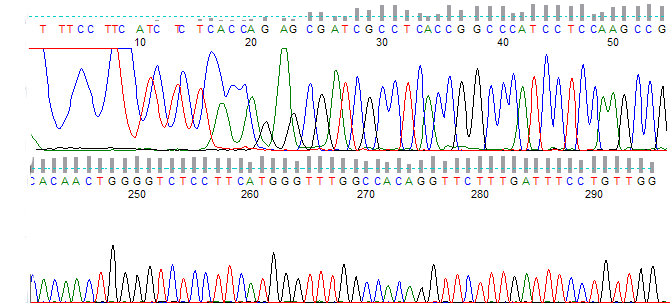
Nucleics SupportKeymasterYou can have low level PCR product contamination in what looks like a single product. What happens is the primer gets to the end of your 90bp product and then the sequencing product for it ends. The signal will drop right down to a very low level and continue off the contaminating product. Even though this might only be 1/1000th the level of the main product there is enough of it there to give a sequencing signal once the main product ends. You don’t see this in the first 90bp because the signal level is too low, it is only when teh stronger signal ends that this background signal is observed.
Daniel Tillett
Nucleics SupportKeymasterI suspect that you may have PCR contamination of your primers or PCR buffer. This could then give rise to PCR product in the sequencing reaction. You may want to try doing a sequencing reaction without any product and see what you get.
Daniel Tillett
Nucleics SuppoKeymasterHi Emily
I think you are right – I have not seen any other software around like it either 🙂
Daniel Tillett
Nucleics SupportKeymasterHi Emily
Yes I have seen this software before too – the same as you I can’t remember what it is called. I will take a look around and if I can find it I will post it here.
Edit. Found it. The software is called Mutation Surveyor and is sold by softgenetics.
Daniel Tillett
Nucleics Support -
AuthorPosts