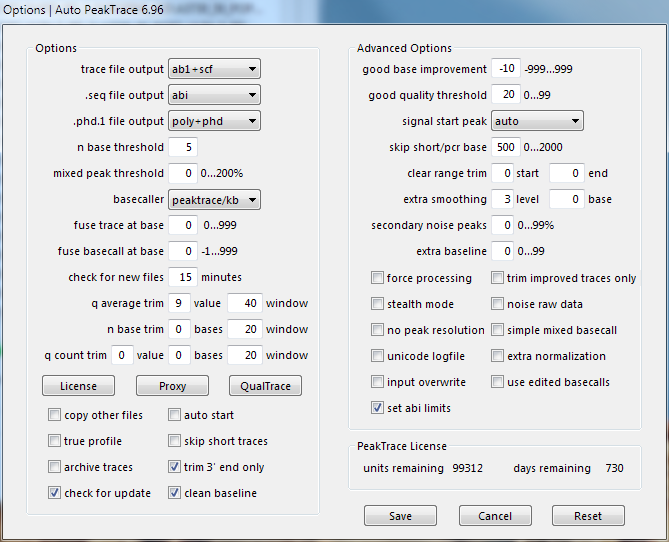
PeakTrace 6 (Auto PeakTrace 6, Auto PeakTrace 6 RP and Linux PeakTrace 6) has a number of powerful options that many users of older versions may not have explored. We know most of our customers are busy running a sequencing facility and don’t always have time to look into each new feature on release, so we have written a series of posts on what each option does, when to use it, and how it can help you get the most from PeakTrace.
Below, all 33 options are grouped by the job they do, each with a one-line summary and the setting name as it appears in the Options window. Many are also available in PeakTrace Online Pro (see the Online Pro settings guide).
Choosing and combining basecallers
Which traces PeakTrace basecalls, and how its output is merged with KB.
- Skip Short TracesLeaves short reads, which KB already calls well, untouched.
- PeakTrace Basecalling with KB FallbackFor traces PeakTrace can’t improve: copy the original unchanged, or tidy the KB trace with Clean Baseline, Extra Baseline and Extra Normalization.
- Fuse Trace and Fuse BasecallJoins KB and PeakTrace output in one trace to get the best of both.
- Use Edited BasecallsKeeps your manual basecall edits when fusing traces or basecalls.
Trimming
Removing low-quality bases from the ends of the read.
- Q Average TrimClips both ends where the average quality in a sliding window falls below a threshold.
- Q Count TrimClips the ends based on how many bases in a window fall below a quality threshold.
- N Base TrimClips the ends where a window contains more than a set number of N calls.
- Clear Range TrimTrims a set number of bases from the start and sets the length of the sequence kept.
- PCR Trim BaseRaise the PCR trim point above 500 bases so long PCR products end at the fragment, not in contamination signal.
- Trim 3′ End OnlyTrims the low-quality 3′ end while keeping the 5′ start.
- Trim Improved Traces OnlyApplies trimming only to the traces PeakTrace actually basecalled.
- Set ABI LimitsSoft (virtual) trimming, as KB does, instead of removing the bases.
Difficult signal
Settings for traces with production problems.
- Automatic Bubble Spike RemovalRemoves the sharp all-channel spikes caused by gas bubbles passing the detector.
- Extra NormalizationHelps ‘ski-slope’ traces whose signal falls away rapidly along the read.
- Force ProcessingBasecalls traces PeakTrace would normally reject as poor quality, and explains the pitfalls.
Mixed bases and polymorphisms
Detecting and measuring mixed (polymorphic) positions.
- Mixed Basecalling and Simple Mixed BasecallingHow PeakTrace 6 calls mixed bases, and how this differs from KB.
- Mixed Peak Threshold over 100%With Clean and Extra Baseline, values above 100% remove minor secondary peaks and keep major ones, without calling mixed bases.
- Picket Fence Trace BasecallingNormalizes all peaks to a similar height, making polymorphic sites easier to quantify.
- No Peak ResolutionMinimally processed peaks, as close to the raw data as possible, to show true relative peak heights.
Trace appearance
Cosmetic settings: they change how the trace looks, not the basecall.
- Clean BaselineRemoves small noise peaks so traces look cleaner to your end users.
- Extra BaselineGoes further than Clean Baseline, removing dye blobs and baseline noise without changing base or quality calls.
- Extra Smoothing Part IUses No Peak Resolution to make PeakTrace peaks look more like KB peaks.
- Extra Smoothing Part IIAdjustable smoothing (levels 1 to 9) from a chosen base, for fine control of peak sharpness.
- True ProfilePeak heights follow the raw signal intensity, as in ABI’s True Profile, instead of the default flat profile.
- Secondary Noise PeaksAdds small artificial secondary peaks so traces look closer to KB output.
Output files and reports
What PeakTrace writes, and how it is labelled.
- QualTrace III Trace ReportsText reports for each trace explaining why quality is poor and what to do about it.
- .poly File OutputPHRED .poly files listing peak positions, areas and amplitudes for each call.
- Noise Raw DataReplaces the raw data so traces can’t be accidentally reprocessed back to KB calls.
- Stealth ModeRecords KB 1.4 rather than PeakTrace in .phd.1 and .scf files, and why we’d rather you didn’t.
- Unicode LogfileUnicode log files and support for non-English folder names (Windows only).
Running Auto PeakTrace unattended
Folder and start-up settings for Auto PeakTrace.
- Auto StartStarts processing as soon as Auto PeakTrace opens, for example after a server reboot.
- Archive TracesMoves processed input files into an ‘archive’ sub-folder so they aren’t reprocessed.
- Input OverwriteLets the input and output folders be the same, overwriting the original files.