• Skip to main content
  • Skip to primary sidebar

Nucleics

  • PeakTrace
    • About PeakTrace
    • PeakTrace Online
    • PeakTrace Online Pro
    • Online Pro for RP customers
    • PeakTrace 6
    • PeakTrace:Box
    • PeakTrace RP
    • PeakTrace for Chromas
    • Buy PeakTrace
    • Why use PeakTrace?
    • Validation of PeakTrace
    • PeakTrace FAQ
    • PeakTrace In Depth
  • DNA Sequencing Products
    • PeakTrace Basecaller
    • PeakTrace:Box
    • PeakTrace RP
    • PeakTrace for Chromas
    • QualTrace
    • LongTrace
    • CounterTrace
    • dLUTE SEQ
    • UniSeq
    • ASIN
  • Support & Services
    • PeakTrace Online Pro Registration
    • QualTrace III Online
    • DNA Sequencing Troubleshooting Guide
    • PeakTrace RP Downloads
    • PeakTrace:Box Downloads
    • Trace Viewers
    • User Manuals
    • Help Guides
      • How to Install Auto PeakTrace 6
      • How to Upgrade to Auto PeakTrace 6
      • How to Update the PeakTrace License on Linux
      • How to Generate a cmDust File
      • Online Activation of Auto PeakTrace 6
      • Auto PeakTrace 6 Online Activation Guide
      • DNA Sequencing Protocols
        • DNA Sequencing Protocol Tips
        • Exonuclease I – Shrimp Alkaline Phosphatase Clean Up of PCR Products
        • Tris EDTA DNA Sequencing Resuspension Buffer
        • DNA Sequencing Reaction Clean-up using Phenol & Butanol
    • DNA Sequencing Service Reviews
    • Software Downloads
    • MSDS
    • Services
      • Genomics Sequencing
      • Bioinformatics
  • Forum
    • Register
    • Login
    • PeakTrace Basecaller Forum
    • PeakTrace:Box Forum
    • Auto PeakTrace RP Forum
    • QualTrace Forum
    • DNA Sequencing Forum
    • DNA Sequencing Software
    • PCR Forum
    • DNA Isolation Forum
    • LongTrace Forum
    • dLUTE SEQ Forum
  • About
    • Contact
    • News
    • Jobs
    • Nucleics Privacy Policy
Buy PeakTrace

Daniel

PeakTrace 6.11 Linux x86_64 Released

November 11, 2015 By Daniel

Historical Release Note (2016): Newer Linux builds of PeakTrace are available on the PeakTrace:Box Downloads page, or you can run PeakTrace in any browser on Linux using PeakTrace Online Pro.

We have released PeakTrace 6.11 for x86_64 Redhat/CentOS 6. This update has many improvements and enhancements over previous versions and is a recommended update for all users of the linux version of PeakTrace. The full list of changes

  • New Feature. PeakTrace basecalling with improved KB Basecaller™ trace processing fall back.
  • New Feature. User controlled extra smoothing of traces via the -xs option.
  • New Feature. Limit trimming to the 3′ end of the trace only via the -ts option.
  • New Feature. Manual control of the skip short base threshold.
  • New Feature. Set use of the edited basecalls within the trace.
  • New Feature. Picket Fence trace output.
  • New Feature. Simple mixed basecalling.
  • Improved fuse trace of repeat sequence regions.
  • Improved fuse basecall of repeat sequence regions.
  • Improved basecalling of mixed peaks.
  • Bug fixes.

PeakTrace 6.11 can be obtained from the Nucleics Downloads page. If you need the password to access the downloads page please contact us at {This email is obscured. Your must have javascript enabled to see it}.

Filed Under: linux, New Release, PeakTrace

Auto PeakTrace 6.10 Released

November 9, 2015 By Daniel

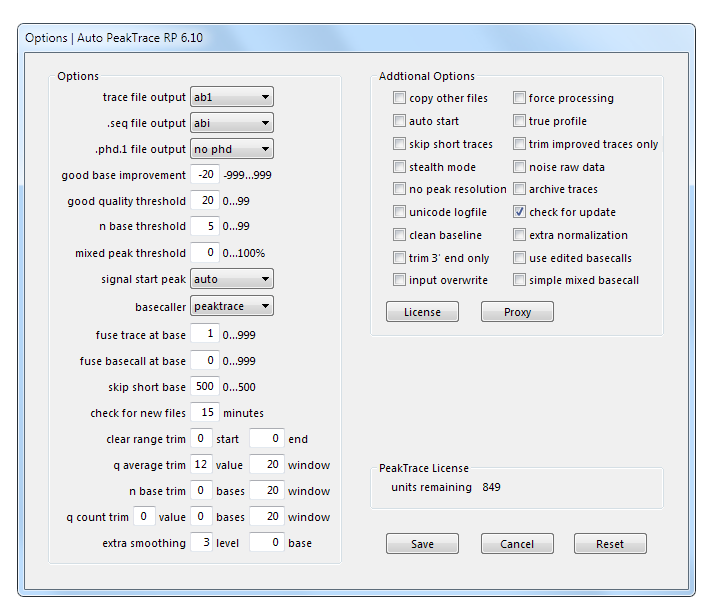
Auto PeakTrace 6.10 Options Window

We have released the latest version of Auto PeakTrace – 6.10. This update is a major release incorporating a large number of improvements and enhancements. The list of changes includes:

  • New Feature. PeakTrace basecalling with improved KB Basecaller™ trace processing fall back.
  • New Feature. User controlled extra smoothing of traces.
  • New Feature. Limit trimming to the 3′ end of the trace only.
  • New Feature. Manual control of the skip short base threshold.
  • New Feature. Set use of the edited basecalls within the trace.
  • New Feature. Set the output to overwrite the input traces.
  • New Feature. Picket Fence trace output.
  • New Feature. Simple mixed basecalling.
  • A reorganized and simplified Options window (see above)
  • Improved fuse trace of repeat sequence regions.
  • Improved fuse basecall of repeat sequence regions.
  • Improved basecalling of mixed peaks.
  • Bug fixes.

These new features are significant and I will be writing about how to best make use of the new features over the coming weeks. Auto PeakTrace 6.10 can be downloaded from the Nucleics Downloads page. If you need the password to access this page please contact us @ {This email is obscured. Your must have javascript enabled to see it}.
 

Filed Under: New Release, news, PeakTrace, QualTrace

What settings are used with the free version of PeakTrace?

November 8, 2015 By Daniel

A question we get asked occasionally is what PeakTrace Basecaller settings are used with the free PeakTrace Online version? Because the online version is intended to support the widest range of sequencer run conditions, while showing (some) of the power of PeakTrace, it uses a set of conditions rather different to default values. The free version of PeakTrace uses the linux command line software with the following options settings:

-ft 300 -c -40 -wq 12 20 -xb 7 -cb yes -bc pk -ts no -xs 1000 2 -sm 700

These values correspond to the Auto PeakTrace and Auto PeakTrace RP Option settings:

  • fuse trace at base: 300
  • good base improvement: −40 bases
  • q average trim: 12 threshold; 20 base window
  • clean baseline: checked
  • extra baseline: 7
  • basecaller: peaktrace/kb (PeakTrace Basecalling with KB Fallback)
  • trim 3’ end only: checked
  • extra smoothing: level 2; start base 1000
  • skip short/pcr base: 700

These settings are not suitable if you are trying to detect polymorphic sites (i.e. mixed peaks). For this you need to use a paid version of PeakTrace and a mixed peak threshold above the default 0.

The PeakTrace default values are usually the best place to start, but you should always trial the various options to find what works best for your needs.  If you would like further advice on the best settings to use with your sequencing data, please don’t hesitate to contact us @ {This email is obscured. Your must have javascript enabled to see it}.
Filed Under: How-to, linux, PeakTrace, PeakTrace RP, windows

Auto PeakTrace RP 6.10 Software Released

November 6, 2015 By Daniel

Auto PeakTrace 6 RP 6.10 Options Window
Auto PeakTrace RP Options Window.


We have released Auto PeakTrace RP 6.10. This is a major update to our PeakTrace RP software and offers a number of improvements and new features that have resulted from our customers’ suggestions as well as the usual bug fixes. The full list of changes is.

  • New Feature. Manual control of the skip short base threshold.
  • New Feature. Limit trimming to the 3′ end of the trace only.
  • New Feature. Set use of the edited basecalls within the trace.
  • New Feature. Set the output to overwrite the input traces.
  • New Feature. Picket Fence trace output.
  • New Feature. PeakTrace basecalling with KB fall back.
  • New Feature. Simple mixed basecalling.
  • A reorganized and simplified Options window.
  • Improved fuse trace of repeat sequence regions.
  • Improved fuse basecall of repeat sequence regions.
  • Improved basecalling of mixed peaks.
  • Bug fixes.

I will be writing posts on the new features over the coming weeks as they provide some very interesting and useful features.

This major update is available from the Nucleics Downloads page and it is highly recommended that all users of PeakTrace RP upgrade to this version.

Filed Under: macosx, New Release, news, PeakTrace RP, windows

PeakTrace Online Now Using PeakTrace 6.10

November 5, 2015 By Daniel

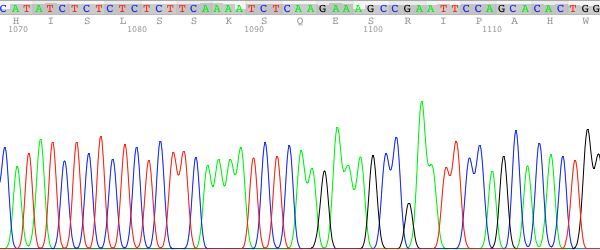
PeakTrace 6.10 chromatogram from about base 1068 to 1115, with sharp, well-separated peaks
Example PeakTrace 6.10 Trace

The free version of the PeakTrace Basecaller™ (PeakTrace Online) has been updated to PeakTrace 6.10. This is a major update of the PeakTrace Basecaller and it includes a large number of enhancements and new features. The Auto PeakTrace RP™ and PeakTrace:Box™ will be released over the next few days.

Filed Under: news, PeakTrace

Has the KB Basecaller been Validated?

October 17, 2015 By Daniel

Mapping comparison of PeakTrace and KB

We occasionally get asked if the PeakTrace Basecaller™ has ever been independently validated? The answer is no one has ever published an independent validation of any Sanger DNA sequencing basecaller. This includes the widely used KB Basecaller™.

The most complete published study on basecaller validation is Ewing and Green’s 1998 paper on the validity of phred [1]. This study was performed by the same team that developed phred [2] so while very thorough, it is far from an independent study.

The KB Basecaller™ has no published studies on its validation beyond a single poster at Advances in Genome Biology and Technology (AGBT) in 2004 by the team that developed KB [3]. While this poster showed that KB gave more Q20+ bases than phred, these extra Q20+ bases didn’t seem to help much when the data was used (i.e. in assemblies – see Figure 5 on this poster).

The ABI 3500 DX model has been approved for clinical testing by the FDA [4], however, the validation of KB done for this approval was performed by ABI and is limited to the ABI 3500 DX model when using POP6™, BigDye™ v1.1, the 3500 Dx Series Data Collection Software 1.1, and one of two run conditions [5]. If you are running any other sequencing instrument, polymer, BigDye, or run condition then KB has not gone through the FDA validation process. You can’t assume that KB will give valid results under your run conditions just because it has been validated for a particular instrument, consumable set, and run conditions.

It is totally understandable why ABI (ThermoFisher these days) has only undertaken the FDA approval process for the ABI 3500 DX and only under a very limited range of conditions. The FDA process takes years, costs millions of dollars, and needs to be done separately for each instrument, polymer, terminator chemistry, capillary length, and run module. Even for a company as large as ThermoFisher it does not make sense to go through the FDA process for every sequencer it has ever sold.

The closest to an independent study of the KB Basecaller we have been able to find was a paper published by Hyman et al. in 2010 [4]. They did not perform a full validation (as was done by Ewing and Green for phred), but they did find that KB gave more Q20+ bases than phred. They also found that these extra Q20+ bases did not help them in their application of identifying bacterial species from the sequence data [4].

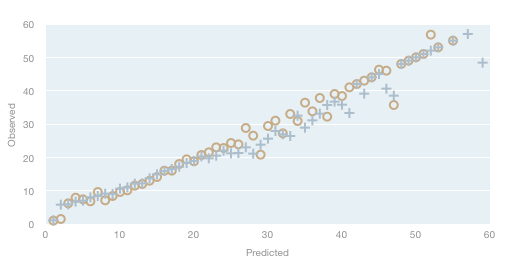
In defense of the KB Basecaller our own validation studies show that KB is basically fine except for a few problems in the Q20 to Q30 range where it tends to over predict the actual quality [7]. For almost all non-clinical applications this is not a major issue, but it may explain why there has been little or no benefit seen from the greater Q20+ bases that KB provides over phred.

The bottom line is KB (like phred) has been validated by the people who wrote it, but no one has published an independent validation of either of these basecallers except ironically us [7]. If you demand that a basecaller be independently validated before you will use it then the only independent study you can turn to is ours of KB (we have also validated phred, but this has not been made public). If you trust us to validate KB, then you can trust us to validate PeakTrace too.

So where does this leave the validation of the PeakTrace Basecaller? Nucleics has extensively validated PeakTrace [7] in exactly the same manner as was done by the developers of the phred [1] and KB basecallers [3]. PeakTrace is currently being used in 93 facilities around the world to basecall tens of millions of traces per year. Our customers would not pay the extra cost for using PeakTrace – after all they get the KB Basecaller for free with the instrument – if they did not believe it provided real and significant improvement.

Of course the best validation is always your own validation. For almost all applications it does not matter if, for example, a predicted Q31 base has a true Q31 error rate (or if it is actually Q29 or Q33), what matters is the number of actual errors, the usable read length, and that bad bases are not called as good bases. We have yet to see an application (even clinical) where it matters if a base is given a Q score more accurate than to the nearest Q10.

Luckily it is very easy to do a quick, do-it-yourself validation of PeakTrace. Just grab a handful of good traces of known sequence, run them through the free online PeakTrace service, then BLAST both the KB and PeakTrace sequence data to compare the errors and aligned bases found with each basecaller. This will quickly tell you which basecaller is best for your data. If you follow this process we are sure you will be impressed with how PeakTrace performs.

References

  1. Ewing B, & Green P. (1998). Base-calling of automated sequencer traces using phred. II. Error probabilities. Genome Res. 8:186-194.
  2. Ewing B, Hillier L, Wendl MC, Green P. (1998). Base-calling of automated sequencer traces using phred. I. Accuracy assessment. Genome Res. 8:175-185.
  3. Longer Reads and More Robust Assemblies with the KB Basecaller (2004)
  4. http://www.fda.gov/downloads/BiologicsBloodVaccines/BloodBloodProducts/ApprovedProducts/SubstantiallyEquivalent510kDeviceInformation/UCM339686.pdf
  5. https://tools.thermofisher.com/content/sfs/brochures/3500-dx-series-genetic-analyzer-cs2.pdf
  6. Hyman RW, Jiang H, Fukushima M, Davis RW. (2010). A direct comparison of the KB™ Basecaller and phred for identifying the bases from DNA sequencing using chain termination chemistry. BMC Research Notes. 3:257.
  7. Tillett D. (2010). Validation of the PeakTrace Basecaller.

Filed Under: DNA sequencing reviews, news, PeakTrace, PeakTrace RP

Additional 38 DNA sequencing service reviews added

October 6, 2015 By Daniel

We have added another 38 reviews of DNA sequencing service providers. These include

  • Acadia Research Laboratories
  • Avance Biosciences
  • Clemson University Genomics Institute
  • East Tennessee State University Core Facility
  • Emory University Integrated Genomics Core
  • Epoch Life Science
  • Eurofins Genomics USA
  • Florida International University DNA Core Facility
  • HudsonAlpha Institute for Biotechnology Genome Sequencing Center
  • Lone Star Labs, Inc.
  • North Carolina State University Genomic Sciences Laboratory
  • Oblique Bio
  • Omega Bioservices
  • Pennington Biomedical Research Center Genomics Core
  • Texas A&M AgriLife Research Laboratory for Genome Technology
  • Texas A&M College of Veterinary Medicine & Biomedical Sciences DNA Technologies Core Lab
  • Texas Tech University Center for Biotechnology & Genomics
  • University of Alabama Heflin Center for Genomic Science
  • University of Arkansas DNA Resource Center
  • University of Arkansas for Medical Sciences DNA Sequencing Core Facility
  • University of Florida Interdisciplinary Center for Biotechnology Research
  • University of Georgia Genomics Facility
  • University of Kentucky Advanced Genetic Technologies Center
  • University of Miami Miller School of Medicine Center for Genome Technology
  • University of Mississippi Medical Center Cancer Molecular and Genomics Core
  • University of North Carolina at Chapel Hill Genome Analysis Facility
  • University of Oklahoma Health Sciences Center LMBCR
  • University of Tennessee Molecular Biology Resource Facility
  • University of Tennessee Health Science Center Molecular Resource Center
  • University of Texas at Austin DNA Core Facility
  • University of Texas MD Anderson Cancer Center Sequencing and Microarray Facility
  • University of Texas Medical Branch Protein Chemistry Laboratory
  • University of Texas Health Science Center at San Antonio Nucleic Acids Core Facility
  • University of Virginia Biomolecular Research Facility
  • University of Virginia Genomics Core Facility
  • UT Southwestern Medical Center McDermott Center Sequencing Core
  • Virginia Tech Bioinformatics Institute
  • Virginia Commonwealth University Nucleic Acids Research Facilities

We hope to have all the reviews finished in the next week or so. If your facility or company is not on the list please get in contact with us.

Filed Under: DNA sequencing reviews, news

Why do only 5 of the 93 DNA sequencing facilities using PeakTrace acknowledge using it?

October 5, 2015 By Daniel

KB bascalling
KB Basecaller
Auto PeakTrace 6
PeakTrace Basecaller

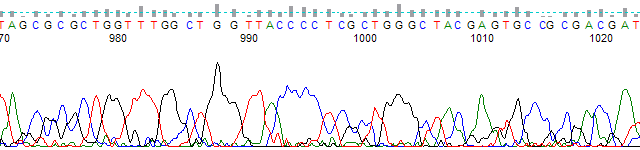
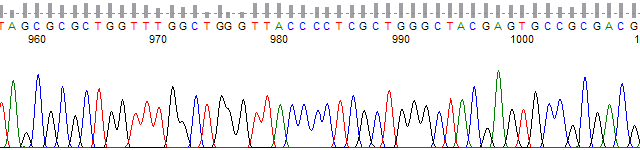
If you look through our list of DNA sequencing facilities reviews you will notice that only 5 of the more than 300 facilities listed publicly acknowledge using PeakTrace, despite 93 sites using it (as of October 2015). Why won’t the other 88 let us say they are using PeakTrace? It is not because they think the product is bad, or that we have not asked them!

The simple answer is they don’t want their competitors to know about PeakTrace. The DNA sequencing service market is very competitive and the facilities using PeakTrace want to keep it all to themselves. The last thing they want is their competitors to start using PeakTrace. When you have access to software that can turn your traces from the top image (called with the KB basecaller) into the bottom image (called with the PeakTrace basecaller) then you know you are onto something fantastic that gives your business a massive edge. If you are at all rational you don’t want your competitors using PeakTrace too. Such are the woes of a business selling a product that is truly unique and valuable.

If you want to see what PeakTrace can do for your traces and facility then trial our free PeakTrace Online service, or download the PeakTrace Whitepaper. If you have any questions about how PeakTrace can help your facility then please get in contact with us at {This email is obscured. Your must have javascript enabled to see it}.
Filed Under: DNA sequencing reviews, news, PeakTrace

Updated DNA Sequencing Service Provider Reviews

October 4, 2015 By Daniel

We have been updating the reviews of DNA sequencing service providers on our DNA Sequencing Service Reviews page. The new reviews include the following facilities and companies. If your facility or company is not on the list we are happy to add it – just get in contact with us.

New Reviews

  • BCH IDDRC Molecular Genetics Core
  • BGI Americas
  • Bio Basic
  • Cornell University Institute of Biotechnology
  • Creative Genomics
  • Dana-Farber/Harvard Cancer Center DNA Core Facility
  • Dartmouth College Molecular Biology Shared Resource
  • Duke University DNA Analysis Facility
  • Georgetown University DNA Sequencing and Fragment Sizing Service
  • GENEWIZ Inc. DNA Sequencing Service
  • Harvard Medical School Biopolymers Facility
  • Hubbard Center for Genome Studies DNA Sequencing Facility
  • Huck Institutes for Life Sciences at Penn State
  • Johns Hopkins University DNA Analysis Facility
  • Macrogen USA
  • Marshall University Genomics Core Facility
  • Napcore The Children’s Hospital of Philadelphia
  • New Jersey Medical School Molecular Resource Facility
  • Penn State Hershey Molecular Genetics Core Facility
  • Roswell Park Cancer Institute DNA Sequencing Facility
  • Sloan-Kettering Cancer Center Core Facility
  • Sequegen DNA Sequencing Service
  • University of Delaware Sequencing & Genotyping Center
  • University of Albany Center for Functional Genomics
  • University of Pennsylvania DNA Sequencing Facility
  • University of Pittsburgh DNA Sequencing Core
  • University of Rochester Functional Genomics Center
  • Wadsworth Center Applied Genomic Technologies Core
  • West Virginia University Genomics Core Facility
  • Vermont Cancer Center DNA Sequencing Core
  • Yale W.M. Keck DNA Sequencing Facility
  • Arizona State University DNASU Sequencing Core
  • Bio Applied Technologies Joint, Inc
  • Brigham Young University DNA Sequencing Center
  • City of Hope Integrative Genomics Core
  • Colorado State University DNA Sequencing Facility
  • Fred Hutchinson Cancer Research Center Genomics Resource
  • HIBM Research Group
  • High Throughput Genomics Center
  • Nevada Genomics Center
  • Oregon State University CGRB Core Facility
  • Polymorphic DNA Technologies
  • Quintara Biosciences
  • Rancho Santa Ana Botanic Garden Core Genetics Facility
  • Seattle BioMed Sequencing Core Facility
  • Scripps Research Institute Center for Protein and Nucleic Acid Research
  • SeqXcel
  • Sorenson Genomics
  • Stanford University Medical Center PAN Facility
  • Synthetic Genomics
  • UC Berkeley DNA Sequencing Facility
  • UC Davis DNA Sequencing Facility
  • UC Riverside Institute for Integrative Genome Biology Genomics Core
  • UC San Francisco Genomics Core Facility
  • University of Alaska Fairbanks DNA Core Facility
  • University of Arizona Genetics Core
  • University of Colorado DNA Sequencing & Analysis Core
  • University of Hawaii Pacific Biosciences Research Center
  • University of Montana Murdock DNA Sequencing Facility
  • University of Nevada, Las Vegas Genomics Core Facility
  • University of Utah DNA Sequencing Core Facility
  • University of Washington School of Pharmacy DNA Sequencing and Gene Analysis Center
  • Utah State University Center for Integrated BioSystems
  • BloodCenter of Wisconsin Molecular Biology Core
  • Case Western Reserve University Genomic Sequencing Core
  • Cincinnati Children’s Hospital DNA Sequencing and Genotyping Core
  • Cleveland Clinic Genomics Core
  • DNA Analysis LLC
  • Ingenbio
  • Indiana University Molecular Biology Institute
  • Indiana University School of Medicine
  • Iowa State University DNA Facility
  • ISU Molecular Research Core Facility
  • Kansas State University
  • Loyola University DNA Core
  • Mayo Clinic Molecular Biology Core
  • Miami University Center for Bioinformatics & Functional Genomics
  • Medical College of Wisconsin Human and Molecular Genetics Center
  • Michigan State University Research Technology Support Facility
  • Northwestern University Genomics Core Facility
  • Ohio State University Plant-Microbe Genomics Facility
  • Ohio State University Comprehensive Cancer Center
  • Ohio University Genomics Facility
  • Oklahoma Medical Research Foundation DNA Sequencing Facility
  • Purdue University Genomics Core Facility
  • Southern Illinois University Core
  • Stowers Institute for Medical Research
  • Taueret Laboratories
  • Washington University Protein and Nucleic Acid Chemistry Laboratories
  • University of Chicago Genomics Facility
  • University of Cincinnati Core Facility
  • University of Illinois at Chicago DNA Services Facility
  • University of Illinois at Urbana High-Throughput Sequencing and Genotyping Unit
  • University of Iowa DNA Facility
  • University of Minnesota DNA Sequencing and Analysis Facility
  • University of Nebraska Medical Center DNA Sequencing and Genotyping Core Facility
  • University of Notre Dame Genomics and Bioinformatics Core Facility
  • University of Wisconsin DNA Sequencing Facility
  • Wayne State University Applied Genomics Technology Center
  • WestCore – Black Hills State University
  • Acadia Research Laboratories
  • Clemson University Genomics Institute
  • East Tennessee State University Core Facility
  • Eurofins Genomics USA
  • North Carolina State University Genomic Sciences Laboratory

Filed Under: DNA sequencing reviews, news

Auto PeakTrace RP and the N base threshold

September 7, 2015 By Daniel

Among the many changes introduced with PeakTrace 6 was an improvement in the PeakTrace basecalling. This has resulted in some bases that had previously been called as Q6 now being called as Q5. Since these bases are unlikely to be useful (a Q5 base is expected to be wrong about 32% of the time, while a Q6 base is expected to be wrong 25% of the time), this change is of minor importance except that it can cause an issue if you are using a very old version of Auto PeakTrace RP (pre-5.70) and have the N base threshold set to 0. If you are you will now see some N bases in your basecall.

If this is an issue for you the best solution is to upgrade to Auto PeakTrace 6 RP since there are a number of new features that can’t be accessed using old versions of Auto PeakTrace RP, however, you can work around this change by setting the N base threshold to 1 rather than 0.

Filed Under: How-to, PeakTrace RP

  • « Go to Previous Page
  • Page 1
  • Interim pages omitted …
  • Page 11
  • Page 12
  • Page 13
  • Page 14
  • Page 15
  • Interim pages omitted …
  • Page 22
  • Go to Next Page »

Primary Sidebar

DNA Sequencing Help

We have added a guide on troubleshooting automated DNA sequencing problems.

DNA Sequencing Service Facilities Reviews

Please see our review of 325 DNA sequencing core facilities and commercial services for more information on selecting the right sequencing service for your needs.

QualTrace III Online

Try the free online version of the QualTrace DNA sequencing QC software and see how real time quality control tracking can improve your read lengths and lower sequencing failure rates.

Contact Details

email. information@nucleics.com
phone. +61 489 152 658
  • home
  • peaktrace
  • software & reagents
  • forum
  • tools
  • services
  • support
  • about

Nucleics

Sanger Sequencing Software

Already have RP units? Run batches in your browser with PeakTrace Online Pro.

©Nucleics 1999 - 2026